Understanding Gestalt Psychology: Awareness, Experience, and Human Connection

Have you ever noticed how one unresolved conversation can affect your mood for an entire day? Or how your body reacts before your mind fully understands what's happening? Our thoughts, emotions, physical sensations, relationships, and environment constantly influence one another. Gestalt Psychology explores this interconnected experience, helping us understand ourselves not as isolated parts, but as whole human beings.
Gestalt Psychology is an approach that studies this interconnected nature of human experience, placing emphasis on awareness, perception, and the present moment. Rather than viewing individuals as separate collections of behaviours or symptoms, Gestalt Psychology explores how people experience themselves within the larger context of their environment, emotions, relationships, and internal processes.

At its core, Gestalt Psychology is based on the idea that human beings naturally seek meaning, balance, and wholeness. The term “Gestalt” itself comes from a German word meaning whole or complete form. The approach suggests that people understand experiences not as isolated parts, but as integrated patterns.
Over time, Gestalt Psychology evolved into what is now widely explored through Gestalt therapy training, experiential learning programs, counseling approaches, and personal development work.
The Foundations of Gestalt Psychology
Gestalt Psychology developed during the early twentieth century through the work of psychologists such as Max Wertheimer, Kurt Koffka, and Wolfgang Köhler, who studied perception and the way people naturally organize experiences into meaningful patterns.
Later, Gestalt Therapy emerged through the work of Fritz Perls, Laura Perls, and Paul Goodman. Their work expanded Gestalt principles into psychotherapy, emotional awareness, and relational dynamics.
One of the central ideas within Gestalt Psychology is that awareness plays an important role in growth and change. Instead of focusing only on analysing the past, Gestalt approaches often emphasize:
Present moment awareness
Direct experience
Emotional authenticity
Personal responsibility
Relationship between self and environment
The focus is not simply on discussing experiences intellectually, but on becoming aware of how emotions, thoughts, bodily sensations, and behaviours are experienced in the present moment.
How Gestalt Psychology Is Structured
A Gestalt Psychology learning process is generally experiential rather than purely theoretical. The emphasis is placed on observation, awareness, interaction, and reflection, allowing participants to explore how experiences unfold in real time.
Most Gestalt therapy training programs are structured around three broad areas:
1. Understanding Awareness and Perception
The foundational stage explores how individuals perceive themselves and their environment, and how meaning is created through experience.
Key areas of exploration include:
Memory and cognition
Emotional awareness
Perception and interpretation
Behavioural patterns
Relationship dynamics
Presence and mindfulness
Purpose: To understand how individuals organize experiences, interpret events, and create personal meaning.
2. Understanding Human Interaction
Gestalt Psychology places strong emphasis on contact — the way individuals interact with themselves, other people, and the world around them.
This stage involves exploring:
Communication patterns
Relationship dynamics
Emotional responses
Awareness of bodily sensations
Present-moment experiences
Focus: To understand how people experience interactions, rather than simply analysing outcomes or behaviours.
3. Integration Through Experience
A major aspect of Gestalt therapy training is experiential learning. Participants are encouraged to engage actively so that awareness develops through direct experience.
Common learning methods include:
Observation exercises
Role play
Reflection activities
Group interaction
Guided awareness activities
Experiential demonstrations
Emphasis: The learning process is centred on direct experience and personal observation, rather than only conceptual understanding.
What Is Explored in Gestalt Psychology Training
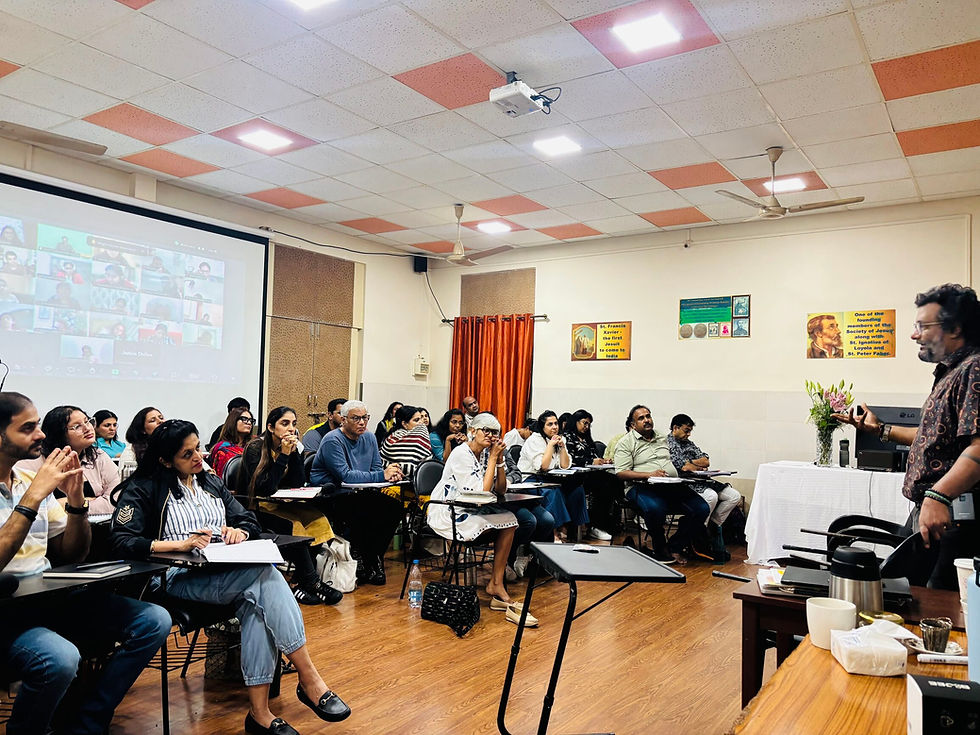
Our Gestalt Psychology training combines theoretical understanding with experiential application. The learning process includes pre-work, live sessions, peer interaction, guided exercises, and integration activities designed to deepen awareness and understanding.
The intention is not simply to study psychological concepts, but to explore how awareness, perception, emotions, and relationships function in real-life experiences. Throughout the training, participants engage with the following areas:
1. Foundational Concepts
The pre-work stage introduces participants to the core principles of Gestalt Psychology, providing a strong foundation for the experiential learning that follows.
Key areas of exploration include:
Introduction to Gestalt principles
Memory and cognition
Language and experience
Trauma and awareness
Psychodrama
Role identity
Polarity and balance
Unfinished emotional experiences
Purpose: To build an understanding of how individuals perceive themselves, relate to others, and make meaning of their experiences.
2. Awareness and Present-Moment Experience
A central focus of Gestalt therapy training is cultivating awareness of the present moment. Participants learn to observe their thoughts, emotions, bodily sensations, and interactions as they unfold.
Participants explore concepts such as:
Sensing contact
Emotional awareness
Bodily sensations
Environmental perception
Mindfulness in interaction
Focus: To develop the ability to notice experiences as they arise, rather than immediately analysing, judging, or suppressing them.
3. Understanding Emotional Patterns
Gestalt Psychology explores how unresolved experiences and internal conflicts continue to influence present behaviour, emotions, and perception.
Topics covered include:
Unfinished business
Figure and ground
Pendulum theory
Collapsing polarities
Emotional integration
Purpose: To understand how conflicting internal states and unresolved emotional experiences can shape current patterns of thinking, feeling, and responding.
4. Experiential Techniques
Experiential learning is one of the defining characteristics of Gestalt Psychology. Rather than relying solely on discussion, participants engage in practical exercises that encourage awareness, expression, and reflection.
Participants may explore techniques such as:
The Empty Chair technique
Psychodrama
Role exploration
Guided dialogue
Awareness exercises
Systemic constellation work
Emphasis: These experiential approaches are used to explore emotions, communication patterns, and interpersonal dynamics through direct participation and observation.
5. Communication and Relationship Dynamics
Gestalt approaches place significant importance on authentic communication and the quality of human relationships. Participants explore how they relate to themselves and others in everyday interactions.
Key areas of exploration include:
Presence in communication
Contact and withdrawal
Relational awareness
Emotional authenticity
Conflict awareness
Goal: To develop a deeper understanding of interpersonal relationships, communication patterns, and the role of awareness in creating meaningful connections.
Gestalt Psychology vs. Gestalt Therapy: Understanding the difference
Although Gestalt Psychology and Gestalt Therapy share the same word gestalt they are not the same. Gestalt Psychology is a theoretical school of psychology, while Gestalt Therapy is an experiential and therapeutic approach that developed later. Understanding the distinction between the two provides valuable context for anyone exploring Gestalt as a field of study, personal development, or professional practice.
What Is Gestalt Psychology?
Gestalt Psychology originated in the early 20th century through the work of psychologists such as Max Wertheimer, Kurt Koffka, and Wolfgang Köhler. Their research focused on how people perceive, organize, and make sense of their experiences. Rather than viewing thoughts and perceptions as isolated elements, Gestalt Psychology proposed that the human mind naturally organizes information into meaningful patterns and complete wholes. This idea is often expressed through the principle that "the whole is greater than the sum of its parts."
The field primarily explores areas such as perception, cognition, learning, memory, and problem-solving, helping explain how people interpret the world and construct meaning from their experiences.
What Is Gestalt Therapy?
Gestalt Therapy was developed several decades later by Fritz Perls, Laura Perls, and Paul Goodman. While it was inspired by the holistic principles of Gestalt Psychology, it evolved into a distinct approach focused on awareness, emotional experience, and authentic human connection.
Instead of concentrating primarily on perception, Gestalt Therapy encourages individuals to become aware of their thoughts, emotions, bodily sensations, behaviours, and relationships in the present moment. The emphasis is on understanding how people experience themselves and others, rather than simply analysing why they think or behave in certain ways. Through increased awareness, individuals can better understand their patterns of interaction, take greater personal responsibility, and develop more authentic ways of relating to themselves and the world around them.
How Are Gestalt Psychology and Gestalt Therapy Connected?
The connection between Gestalt Psychology and Gestalt Therapy lies in their shared belief that human experience is best understood as an integrated whole rather than as separate parts. Gestalt Therapy adopted this holistic perspective from Gestalt Psychology but expanded it far beyond the study of perception.
In addition to Gestalt Psychology, Gestalt Therapy draws on ideas from existential philosophy, phenomenology, field theory, and humanistic psychology. These influences transformed the original psychological concepts into an experiential approach that explores awareness, emotions, relationships, communication, and the interaction between individuals and their environment.
While Gestalt Psychology explains how people organize and interpret their experiences, Gestalt Therapy focuses on how becoming more aware of those experiences can support personal growth, emotional understanding, and meaningful relationships.
The Key difference
The most significant difference lies in their purpose and application.
Gestalt Psychology is primarily concerned with understanding how the human mind perceives, organizes, and interprets information. It is a field of psychological study that seeks to explain the processes behind perception, cognition and learning.
Gestalt Therapy, on the other hand, is an experential and applied approach that uses awarenes, dialogue and present moment experience to help individuals explore their emotions, relationships, behaviours, and patterns of interaction. Rather than simply explaining how the mind works it provides practical methods for increasing self-awareness and supportig personal and interpersonal growth.
Why Understanding Both Matters
Although they serve different purposes, Gestalt Psychology and Gestalt Therapy complement one another. Gestalt Psychology provides the theoretical foundation for understanding how people perceive and organize experience, while Gestalt Therapy builds upon these ideas to create a practical, awareness-based approach to personal development and human connection.
The Experiential Nature of Gestalt Therapy Training
One of the defining characteristics of Gestalt therapy training is its experiential format. Rather than relying solely on lectures or theoretical analysis, learning often takes place through direct participation and observation.
Participants may engage in:
Group processes
Reflection activities
Peer interaction
Awareness exercises
Live demonstrations
Guided experiential work
This structure encourages individuals to observe how emotions, thoughts, behaviours, and relationships unfold in real time.
Many Gestalt Psychology programs also include written integration work, practical demonstrations, and supervised experiential learning to support deeper understanding.
Applications of Gestalt Psychology
Gestalt Psychology is explored across a wide range of personal and professional settings. Its emphasis on awareness, perception, and human connection makes it relevant in fields that involve communication, learning, relationships, and personal growth.
Counseling and Therapy
Gestalt approaches are often explored in counseling and therapeutic settings to help individuals become more aware of their thoughts, emotions, and patterns of relating.
Applications include:
Emotional awareness – Recognising emotions as they arise rather than ignoring or suppressing them. For example, noticing feelings of frustration during a conversation before reacting impulsively.
Present-moment processing – Exploring what is happening in the "here and now" instead of becoming lost in past events or future worries. For instance, observing your thoughts and bodily sensations while discussing a difficult experience.
Relationship dynamics – Understanding recurring interaction patterns. For example, recognising why similar misunderstandings occur in different relationships.
Conflict resolution – Becoming aware of how thoughts, emotions, and communication influence disagreements. For instance, noticing whether you tend to withdraw, avoid, or become defensive during conflict.
Self-awareness – Developing a deeper understanding of personal habits, emotional responses, and behavioural patterns. For example, recognising situations that consistently trigger feelings of self-doubt.
Coaching and Facilitation
Gestalt principles are explored in coaching and facilitation to encourage greater awareness, more effective communication, and intentional decision-making.
Applications include:
Behavioural awareness – Identifying recurring habits and behavioural patterns. For example, noticing a tendency to procrastinate whenever a task feels overwhelming.
Perspective shifts – Looking at situations from different viewpoints. For instance, seeing constructive feedback as an opportunity for growth rather than criticism.
Communication – Becoming more aware of how words, tone, and body language influence conversations. For example, recognising that active listening often improves understanding more than giving immediate advice.
Leadership development – Encouraging leaders to build authentic relationships through awareness and presence. For instance, a manager noticing how their communication style affects team motivation and collaboration.
Education and Training
Educators, trainers, and facilitators may explore Gestalt principles to create more engaging, reflective, and collaborative learning experiences.
Applications include:
Learning experiences – Encouraging learners to actively engage with concepts rather than simply memorising information. For example, reflecting on how a new idea connects with personal experience.
Group dynamics – Understanding how individuals contribute to and influence group interactions. For instance, observing how different personalities affect teamwork during a workshop.
Awareness-based interaction – Helping participants become more conscious of their communication and participation. For example, noticing who naturally leads discussions and who tends to remain quiet.
Communication processes – Exploring how ideas are shared and understood. For instance, recognising how asking open-ended questions encourages richer discussion.
Personal Growth
Many individuals explore Gestalt Psychology and Gestalt therapy training to develop a deeper understanding of themselves and their relationships.
Applications include:
Emotional patterns – Recognising recurring emotional responses. For example, noticing that certain situations consistently lead to feelings of anxiety or frustration.
Relationship experiences – Becoming aware of how personal patterns influence connections with others. For instance, recognising a tendency to avoid difficult conversations.
Internal conflicts – Exploring competing thoughts, feelings, or desires. For example, wanting to pursue a new opportunity while simultaneously fearing change.
Awareness of self and environment – Understanding how thoughts, emotions, bodily sensations, and surroundings interact. For instance, noticing how a busy environment affects concentration, mood, or decision-making.
Common Misconceptions about Gestalt Psychology
As Gestalt Psychology has become more widely discussed in therapy, coaching and personal development, several misconceptions have emerged. Clarifying these can help build a more accurate understanding of what the approach actually explores.
Myth 1: Gestalt is only about therapy
Reality: Not just therapy- it's about people.
Gestalt principles are also explored in coaching, education, leadership, facilitation and personal development.
Myth 2: Gestalt focuses only on emotions
Reality: It's bigger than emotions.
Gestalt look at thoughts, emotions, behaviors, bodily sensations, relationships and the environment as interconnected parts of human experience.
Myth 3: Gestalt ignores the past
Reality: The past matters, the present reveals it.
Gestalt explores how past experiences continue to influence present thoughts, emotions and behavior.
Myth 4: Gestalt is only for therapists
Reality: Anyone who works with people can benefit.
Gestalt is studied by coahces, educators, leaders, facilitators, counselors and individuals interested in personal growth.
Myth 5: Gestalt is about quick fixes
Reality: Awareness over shortcuts.
Gestalt encourages ongoing observation, reflection and experential learning rather than instant solutions.
Awareness as an Ongoing Process
Gestalt Psychology is ultimately centred around awareness; awareness of thoughts, emotions, relationships, bodily sensations, and environmental experiences. Its emphasis on present-moment experience and human connection has contributed to its role across therapy, counseling, coaching, education, and personal development. Rather than focusing only on fixing behaviour, Gestalt approaches often encourage individuals to observe how experiences unfold moment by moment.
Gestalt Psychology begins with a simple idea:
Greater awareness of experience can lead to greater understanding of oneself and others.